How Small Home Service Businesses Can Follow Up on Missed Calls Faster
Charles HigginsAugust 12, 20268 min read
Home service businesses miss 62% of incoming calls, and 85% of those callers never try again. Automated missed-call text-back sends an SMS within 30 seconds, keeping the conversation alive until you can follow up properly.
When a homeowner's water heater fails on a Tuesday morning, they don't wait for callbacks. They scroll through Google results and dial three plumbers in a row. Whoever answers first gets the job. The rest never hear from that customer again, even if they call back 20 minutes later.

The Hidden Revenue Drain: Why Home Service Businesses Miss Most Calls
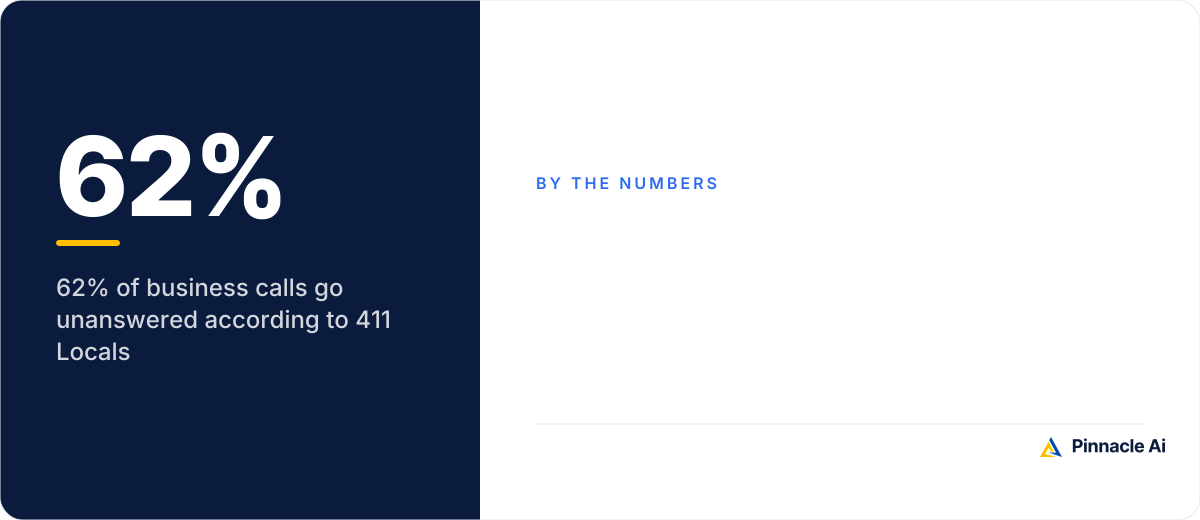
Industry data shows that 62% of business calls go unanswered, and ServiceTitan's analysis of 50,000 contractor phone lines confirms the same 62% missed-call rate across home services. Approximately 85% of those callers never try again. They just move to the next contractor on their list.
This isn't about laziness or bad customer service. Your technicians are on job sites. Your office manager is handling a walk-in customer. You're in a crawl space with no cell signal. The phone rings at 6 p.m. when you've already left for the day. Even well-run plumbing shops miss 27 to 40% of their calls.
The financial impact adds up fast. Home service businesses can miss out on an average of $1,200 per missed call, and the average small business loses approximately $126,000 per year to missed calls. For a two-person HVAC company missing half its calls, that's the equivalent of a full truck and technician sitting idle all year.
The First Responder Advantage: Why Speed Beats Everything
Studies of lead response behavior show that 78% of customers buy from the first company that responds to their inquiry. Not the cheapest. Not the one with the best reviews. The first one who acknowledges them.
Speed matters more than you think. Five-minute response times increase contact rates by 100x compared to waiting 30 minutes. Responding within five minutes makes you 21 times more likely to qualify that lead compared to waiting half an hour.
Your competitors are losing the same race you are. The contractor who can respond in two minutes instead of two hours wins nearly every time.
Why Voicemail Doesn't Work (And What Does)
85% of people who can't reach a business on the first try will not leave a voicemail. They hang up and call the next name on the list. Voicemail feels like a dead end. It requires effort with no guarantee of a callback. Most customers assume that if you didn't answer, you're too busy to help them anyway.
The solution is missed-call text-back. An automated SMS goes out within 30 seconds of a missed call, acknowledging the attempt and opening a conversation immediately. It works even when you're on a ladder, in a meeting, or sound asleep at 2 a.m.
The text doesn't need to book the job. It just needs to keep you in the conversation while your competitor's phone rings unanswered. A simple message buys you time to call back properly without losing the lead in the first 60 seconds.
What to Say in Your Missed-Call Text
Keep the message short, warm, and actionable. Acknowledge the missed call, thank them for reaching out, and invite a reply or offer a next step. Here's an example that works:
Hi, this is Mike from ABC Plumbing. I missed your call but I'm here to help. What can I do for you today? Or click here to book a time that works: [link]
Another option:
Hey, sorry I missed you! This is Sarah at Comfort HVAC. I'll call you back in the next 15 minutes, or you can reply here and tell me what you need.
The goal is not to solve the problem over text. The goal is to signal that you're responsive, human, and ready to help. That keeps you in the running while slower competitors fall out of consideration.
Avoid long paragraphs, business hours disclaimers, or anything that feels like a robot wrote it. The customer called you 90 seconds ago. They want to know someone noticed.
Three Ways to Implement Missed Call Follow Up
You have three options for setting this up, and they vary wildly in reliability and effort.
Manual Follow-Up
You check your missed calls every hour and text people back as fast as you can. This costs nothing but your time, and it fails the moment you're in the field, on another call, or asleep. It also doesn't scale past one person. If three calls come in during a 20-minute job, at least two of them are already gone by the time you look at your phone.
Multiple Separate Tools
You can stitch together a phone system, Zapier, Twilio, and a CRM to trigger automated texts. This works if you have the technical skill to set it up and the patience to troubleshoot it when something breaks. You'll be monitoring multiple dashboards, and replies can get lost if your team isn't watching the right inbox. Monthly costs add up across platforms, and you're often paying per user or per message.
All-in-One Platform
An all-in-one platform detects the missed call, sends the SMS, logs the lead in the CRM, and routes replies to a shared inbox where your whole team can see them. It works out of the box with no technical setup. You get consistent 24/7 response at one flat price with unlimited users. Real humans are available to set it up and run it for you if you don't want to manage it yourself.
This is the approach that scales. It doesn't depend on one person remembering to check their phone, and it doesn't break when you add a second truck or hire an office assistant.
Beyond the First Text: Qualifying and Scheduling Automatically
The best systems don't stop at the first text. They qualify leads over SMS, route them to the right pipeline, schedule appointments, and trigger follow-up sequences without manual effort.
For example, if someone replies "need furnace repair," the platform can ask a few qualifying questions, offer available time slots, and book the appointment automatically. If they don't reply, a second text goes out a few hours later. If they do reply but don't book, a call task gets created for your team.
Everything lives in one shared inbox, so nothing gets missed when the person who sent the first text goes home for the day. You can track how many missed calls turned into booked jobs, how fast your team responds, and which lead sources are worth the money. All of this happens in one place instead of across five browser tabs.
Pinnacle Ai handles missed-call text-back, shared inbox, CRM, appointment scheduling, and automated follow-up sequences in one platform. One flat price, unlimited users, and a team of real people who can set it up and run it for you.
The After-Hours Advantage
Many home service calls come in outside business hours, and these often represent the most urgent and profitable work. A burst pipe at 10 p.m. is not a price-shopping call. The homeowner needs help now and will pay premium rates to get it.
Without automation, you miss 100% of after-hours calls unless you answer your phone at dinner, during your kid's soccer game, or at 2 a.m. Missed call follow up works 24/7 at no extra cost. It captures the lead, opens the conversation, and gives you a chance to respond when you wake up or check your phone between jobs.
Even if you don't offer true emergency service, a text that says "Got your message, I'll call you first thing at 8 a.m." is infinitely better than silence. It keeps you in the conversation and shows the customer you're organized and responsive.
Tracking Whether It Actually Works
You need to know if missed-call text-back is recovering leads or just sending messages into the void. Look for a system that shows you how many texts were sent, how many customers replied, and how many turned into booked jobs or pipeline opportunities.
A shared inbox lets your whole team see every reply in one place, so you can tell at a glance whether responses are being handled or ignored. CRM logging means every missed call becomes a contact record with a full conversation history, so you can follow up days or weeks later if the job didn't close immediately.
The metric that matters most is conversion rate: what percentage of missed calls turn into booked work after you start texting back automatically? If that number is higher than your old voicemail approach, the system is paying for itself.
Common Questions About Missed-Call Text-Back
Is it legal to text someone who called me? Yes. If someone calls your business number, you have implied consent to text them back. You're responding to their inquiry, not sending unsolicited marketing.
Can I still manually reply when needed? Absolutely. The automated text buys you time. You can jump in and reply personally whenever you're available. Your team sees every conversation in the shared inbox and can take over at any point.
Will this work after hours? Yes. Automation runs 24/7. The text goes out whether you're awake or not, and you can follow up manually during business hours.
How much does it cost? Manual follow-up is free but unreliable. Multiple tools can run $100 to $300 per month and require technical setup. An all-in-one platform typically costs one flat monthly rate with unlimited users and no per-message fees.
Does texting back really work better than voicemail? Yes. 85% of callers won't leave a voicemail, but most will reply to a text because it's faster and feels like a real conversation.
What to Do Next
Start by tracking how many calls you miss in a typical week. Check your phone system or call log and count the ones that went unanswered. Multiply that by the number of weeks in a year, then multiply by your average job value. That's your baseline cost of doing nothing.
If you want to recover those leads without hiring more staff or answering your phone at midnight, you need a system that works automatically. Pinnacle Ai combines missed-call text-back, shared inbox, CRM, scheduling, and follow-up automation in one platform. One flat price, unlimited users, and real people to set it up and run it for you.
Watch the demo to see how it works in a real home service business, or try it yourself and send your first missed-call text today.
Want this running in your business?
One flat price, unlimited users, and real people to set it up with you.